
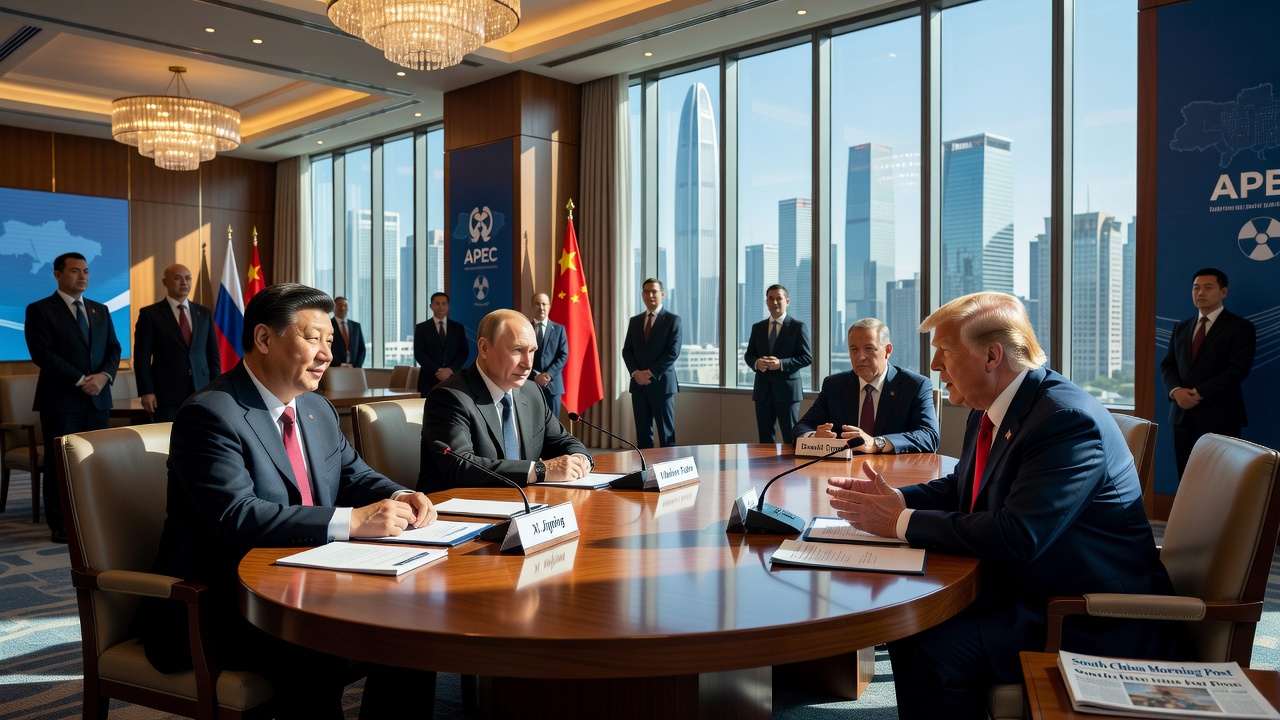
Planning for a possible three-way meeting among President Donald Trump, Chinese President Xi Jinping and Russian President Vladimir Putin at next month's Asia-Pacific Economic Cooperation (APEC) summit in Shenzhen, China, has advanced in recent weeks, according to Kremlin aide Yuri Ushakov. But the three governments remain publicly divided over what such a meeting would actually address, leaving its prospects uncertain.
How the idea surfaced
Ushakov first floated the possibility of a trilateral gathering in early September, during the Shanghai Cooperation Organization summit in Bishkek, Kyrgyzstan, where both Xi and Putin were present. The idea resurfaced more concretely on October 22, when Ushakov said China had "begun preparations" for a Russia-US-China meeting following talks between Putin and US presidential envoy Steve Witkoff. Ushakov added that such a meeting could be placed on the Shenzhen agenda "if circumstances permit."
Putin had proposed the idea on October 19, framing it explicitly as a venue to discuss ending the nearly four-year war in Ukraine. Trump responded a day later, saying he was open to a three-way meeting but describing its purpose differently-focused on nuclear weapons and denuclearization talks involving the US, Russia and China.
A gap in the agenda
That divergence in stated purpose is the central obstacle, according to analysts cited by the South China Morning Post. Beijing has repeatedly resisted Washington's push for trilateral nuclear arms control negotiations, with Chinese officials maintaining that the US and Russia-which hold far larger arsenals-should reduce their own stockpiles substantially before China joins such talks, per analysis from Chatham House.
Wang Wen, a professor at Beijing's Renmin University, has said the agenda itself is "the critical lever for whether a meeting can actually take place." China's Foreign Ministry has so far declined to confirm or deny a meeting is planned; spokeswoman Mao Ning told reporters on October 20 she had "no information to provide," while reiterating Beijing's stated commitment to supporting Ukraine peace efforts.
What China stands to gain or lose
Observers note Beijing's caution reflects a calculated balancing act. Hosting a successful trilateral summit would offer China significant diplomatic visibility and could bolster Xi's domestic standing ahead of the Communist Party's 21st Party Congress. But analysts such as Temur Umarov, a Russia-China relations specialist based in Berlin, argue Beijing has little appetite to take ownership of Ukraine's outcome, suggesting China would participate "not as an active mediator but only as a symbolic partner."
There are also risks. Commentary citing the Wall Street Journal has warned that a US-China-Russia discussion of Ukraine without Kyiv or the European Union at the table could set an uncomfortable precedent-one that observers say might fuel concerns about how similar great-power negotiations could one day treat Taiwan. European capitals are also watching closely, given Xi's stated interest in preserving ties with the EU even while maintaining close relations with Moscow.
What remains unresolved
As of now, no government has confirmed that a trilateral meeting will formally take place in Shenzhen. The mismatched expectations-Ukraine diplomacy versus nuclear arms control-mean the summit's substance, and even its occurrence, remains unsettled. Diplomatic watchers note Beijing has a track record of withholding confirmation on high-profile attendance until shortly before an event, as seen ahead of last month's BRICS summit in New Delhi, suggesting clarity on Shenzhen may not emerge until closer to the APEC gathering itself.