
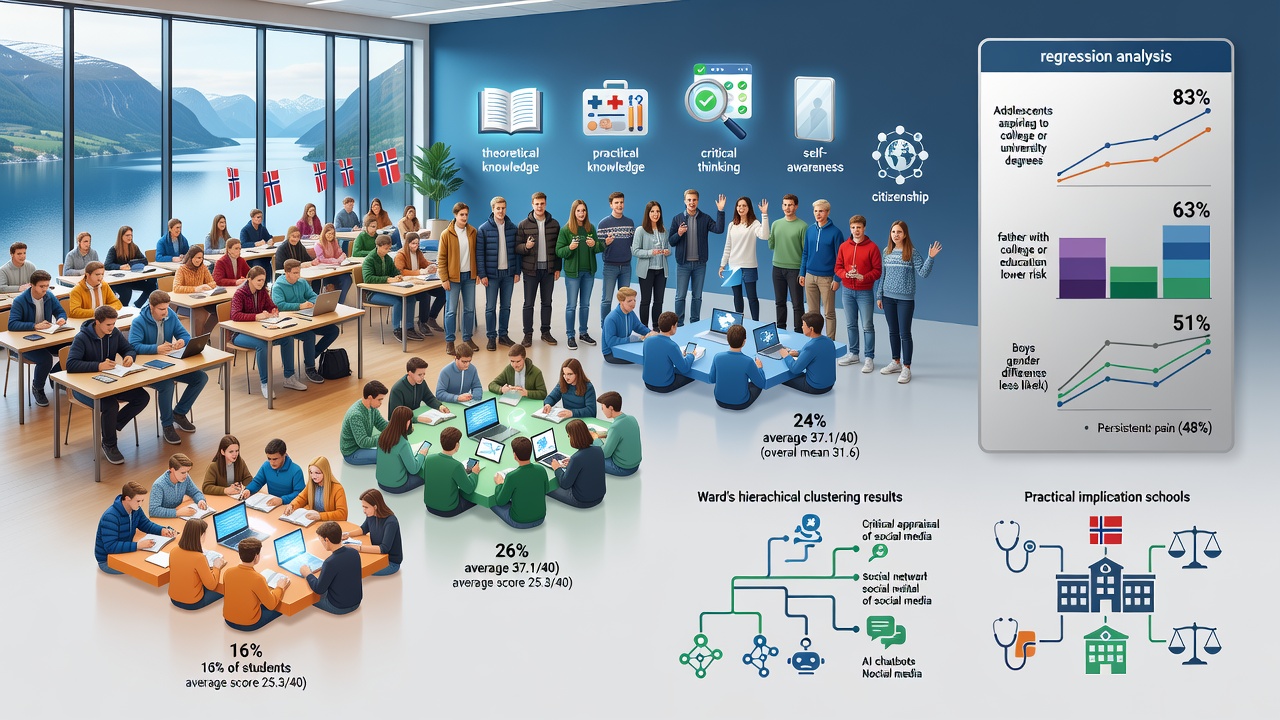
A survey of 440 Norwegian adolescents aged 14 to 16 has found that teenagers' ability to understand and use health information does not fall neatly into a single score or category. Instead, researchers at Oslo Metropolitan University and partner institutions identified four separate clusters of health literacy, suggesting that a single average figure masks substantial variation tied to family background, aspirations and gender.
How the clusters were identified
The research team, publishing in Frontiers in Public Health, used the Health Literacy for School-Aged Children (HLSAC) instrument, which measures five components: theoretical knowledge, practical knowledge, critical thinking, self-awareness and citizenship. Rather than relying on the tool's standard low-moderate-high cut-offs, the researchers applied Ward's hierarchical clustering method, a statistical technique that groups respondents by minimizing differences within each group. After testing solutions ranging from two to five clusters, the team settled on four as the most informative, balancing nuance against group size. The overall mean score was 31.6 out of 40, but that number concealed sharp differences: the lowest-scoring cluster, representing 16 percent of students, averaged 25.3, while the highest-scoring cluster, 24 percent of the sample, averaged 37.1.
Where strengths and gaps appear
Across all four clusters, two components consistently lagged behind the others: critical thinking, the ability to judge whether health information is credible, and citizenship, the capacity to consider how personal choices affect others' health. Even the highest-performing cluster scored lower on these two dimensions than on practical knowledge. The researchers note this pattern may reflect that critical appraisal and civic-minded health reasoning require more cognitive maturity or life experience than simpler recall-based knowledge, though they caution the five components are not strictly sequential and likely overlap. At the individual item level, teens struggled most with generating ideas to improve health in their own surroundings, while they scored highest on following instructions from health personnel.
Family background and aspirations matter more than pain
A regression analysis showed that adolescents who aspired to complete a college or university degree had an 83 percent lower relative risk of landing in the lowest literacy cluster compared with the highest, even after adjusting for other factors. Having a father with a college-level education was linked to a 63 percent lower relative risk of membership in the lowest group. Gender played a narrower role: boys were 51 percent less likely than girls to fall into the second-lowest cluster, a result that contrasts with earlier international research showing girls typically report higher health literacy. Persistent pain, reported by 48 percent of participants overall, did not emerge as a statistically significant predictor of cluster membership, although the lowest-literacy group did include a higher share of adolescents with pain, 56 percent, compared with 43 percent in the highest-scoring group.
Limits and practical implications
The authors are transparent about constraints: the HLSAC tool was originally validated among Finnish adolescents, not Norwegian ones, and no Norwegian reference data exist for direct comparison. The survey relied on self-reported answers, school-level clustering was not statistically accounted for, and participation rates varied between 42 and 66 percent across six schools, with 50 percent overall. Despite these caveats, the findings point toward a practical takeaway for schools and public health programs in Norway and comparable settings: since 71 percent of surveyed teens turn to digital sources, including social media and AI chatbots, for health information, and critical thinking scores lag across every group, building skills to question and verify online health claims may offer one of the more effective, targeted interventions for adolescent wellbeing.