
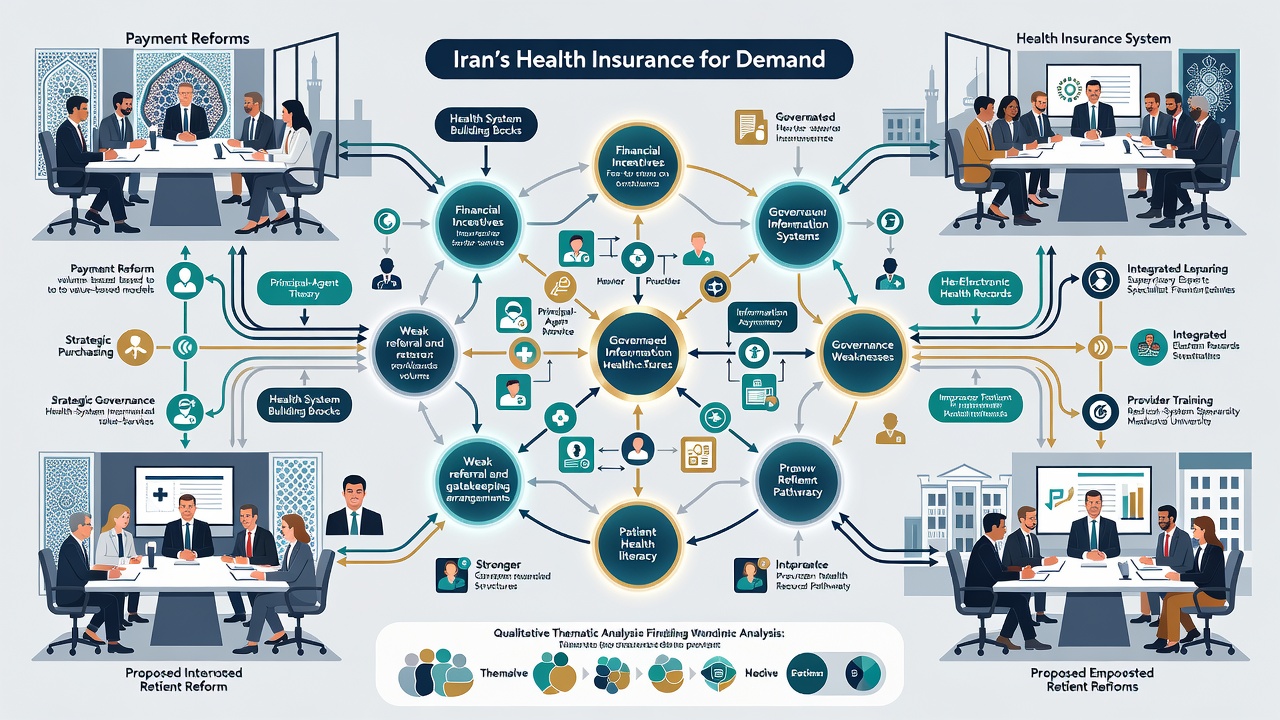
A qualitative study examining Iran's health insurance system has identified six interconnected factors that may contribute to supplier-induced demand - the practice of providers recommending more care than patients medically need. Based on interviews with 25 policymakers, insurance managers and health-system specialists, the research suggests that addressing the issue would likely require coordinated reforms across multiple institutional functions rather than a single policy change.
What the Study Examined
Researchers conducted semi-structured interviews with a purposively selected group of 25 informants, including policymakers, health insurance managers, supervisory experts, health-system specialists and medical university faculty members. The interviews were analyzed using an established qualitative method known as thematic analysis, then mapped onto the World Health Organization's Health System Building Blocks framework and interpreted through concepts of information asymmetry and Principal-Agent Theory - an economic framework describing situations where one party (the agent, such as a provider) may act in ways that don't fully align with another party's (the patient's) interests due to unequal information.
Notably, the study's authors describe their approach as a departure from prior research that focused mainly on individual provider or patient behavior. Instead, they treated supplier-induced demand as a property of an interacting system involving insurers, providers, patients and broader health-system institutions.
Six Domains Identified
Participants pointed to financial incentives - particularly fee-for-service payment models and insurers' dependence on service volume - as especially significant contributors. Other domains included governance weaknesses, such as fragmented oversight and limited accountability; gaps in information systems that could be addressed through integrated health records; weak referral and gatekeeping arrangements associated with unnecessary specialist visits; provider-related pressures like heavy workloads and limited training in resource stewardship; and low patient health literacy, which participants viewed as a factor that could increase vulnerability to unneeded services.
From these themes, the authors built a conceptual framework linking proposed interventions - payment reform, strategic purchasing, stronger governance, integrated information systems, improved referral pathways, provider training and patient empowerment - as interconnected levers rather than standalone fixes.
Important Limits on the Findings
The study describes participants' perceptions rather than measured outcomes. It does not estimate how often supplier-induced demand occurs across the population, document specific patient encounters, or establish that any of the described system conditions directly cause unnecessary care. No control group or before-and-after comparison was used to test whether the proposed reforms would actually work.
The authors themselves note that further research drawing on patient records, frontline-provider data and administrative data would be needed to confirm whether the proposed interactions occur as described and whether reforms reduce unnecessary utilization. For now, the study offers a structured starting point for policy discussion in Iran's health insurance system, not proof that any specific intervention improves care or lowers costs.